
Turning hidden demand into revenue with an enterprise-grade AI agent.
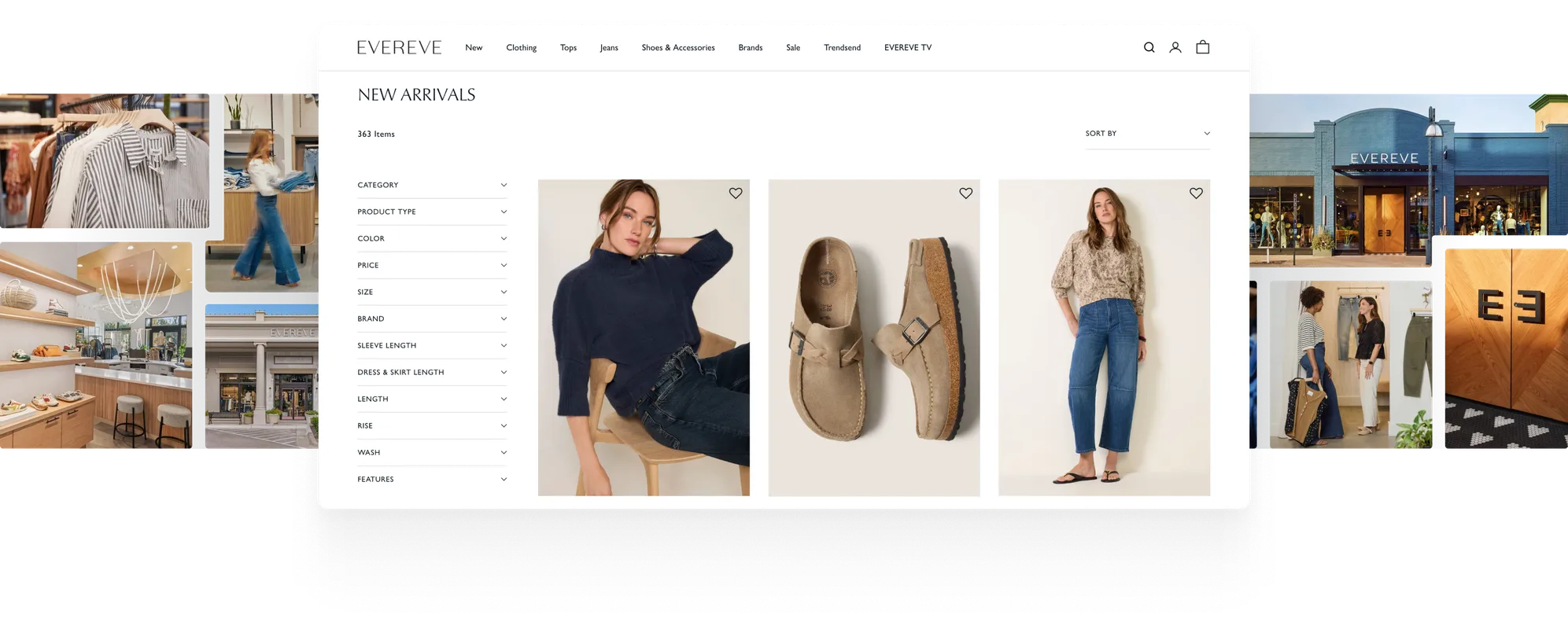
We partnered with EVEREVE to design and build an autonomous AI agent that identifies overlooked revenue opportunities across their product catalog—and acts on them.
EVEREVE is a fashion retailer with a curated, fast-rotating catalog sold through Shopify and marketed through Klaviyo. With thousands of products in motion at any given time, their merchandising and marketing teams faced a familiar challenge: strong products were being missed. Customer interest was there—reflected in traffic, add-to-cart behavior, wishlists, and back-in-stock signups—but the signals were scattered across systems and too numerous to track manually. Revenue was being left on the table, not because the products weren't right, but because the opportunities weren't surfacing fast enough.
We built Eve to close that gap—an AI agent system that continuously scans the catalog, identifies the strongest opportunity, decides what to do about it, and measures whether it worked.

Finding what the catalog can't tell you on its own.
A catalog with thousands of active products generates an enormous amount of signal—page views, conversion rates, velocity trends, wishlist activity, segment affinity—but no single dashboard synthesizes those signals into a clear next action. Merchandising teams were making strong decisions when they had the data in front of them, but the volume of products meant many opportunities passed before anyone noticed.
Rather than building another reporting layer, we built a discovery agent that continuously evaluates the catalog against a structured set of demand indicators: velocity spikes, intent gaps between add-to-cart rates and conversion, back-in-stock demand, wishlist momentum, and segment-level purchasing patterns. Instead of surfacing a long list of possibilities, the agent identifies the single strongest current opportunity and records the evidence behind it—giving the team a focused, data-backed starting point rather than more noise to sort through.
From signal to strategy, without the guesswork.
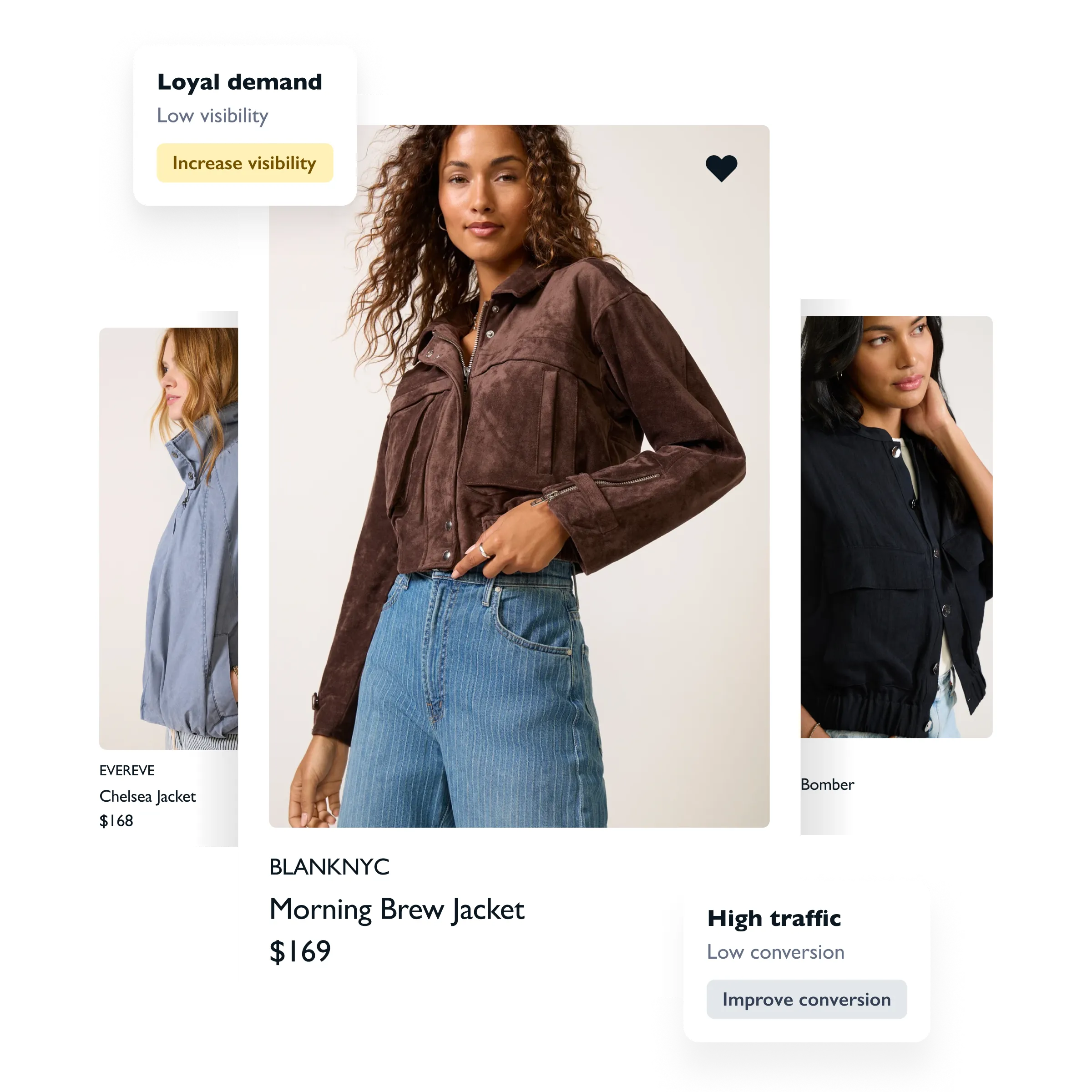
Identifying a product with untapped potential is only useful if you know what's actually holding it back. A product with high traffic but low conversion has a different problem than one that's trending with loyalists but invisible on the storefront. Manually diagnosing these bottlenecks across hundreds of products was impractical, so we built a planning agent that picks up where discovery leaves off. It re-examines fresh data for the identified product, classifies the primary bottleneck—whether it's a traffic problem, a conversion gap, an awareness deficit, or a merchandising blind spot—and then selects one or two targeted interventions from a defined action set. The result is a focused plan grounded in the specific evidence, not a generic recommendation engine suggesting everything at once.
Acting on opportunities before they pass.
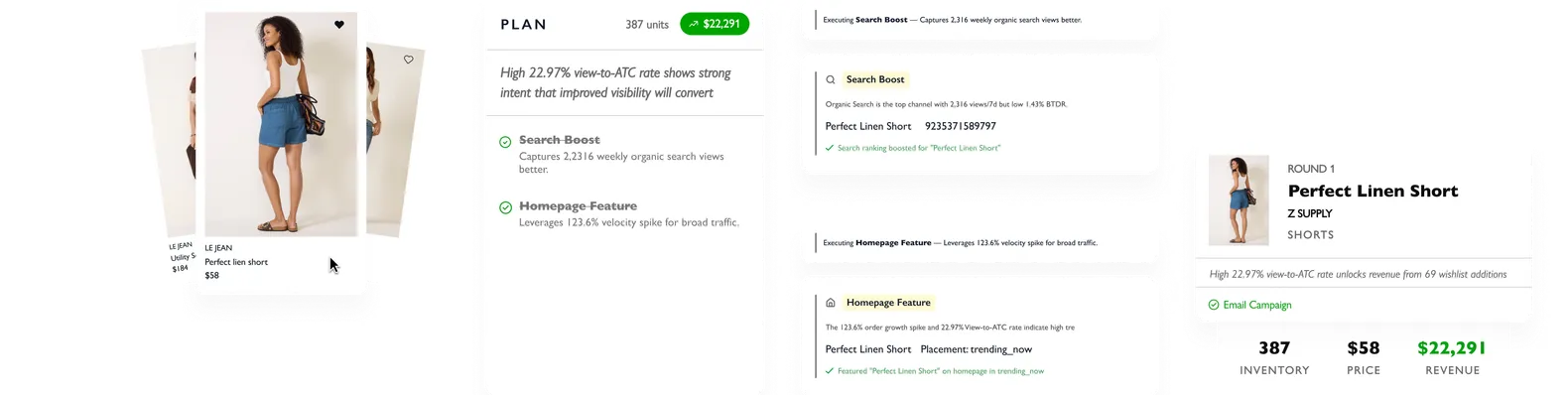
In retail, timing matters. A product showing a velocity spike this week may plateau by next week if nothing changes. Most analytics tools stop at the insight—they tell you what's happening but leave execution to the team. We built Eve to close the loop. Once a plan is approved, the system can feature a product on the homepage through Shopify, boost its search ranking to improve discoverability, or push a targeted email, SMS, or push notification campaign through Klaviyo to the customer segment most likely to convert. Each action is grounded in the specific bottleneck the plan identified, and every execution is recorded so results can be measured against a clear baseline.

Autonomy with guardrails.
Giving an AI system the ability to take real merchandising and marketing actions requires trust—and trust requires control. Rather than building an agent that operates silently, we designed a human-in-the-loop approval system that puts the team in command of every action. When Eve proposes an intervention, it appears in a real-time dashboard with the full reasoning behind it: which product, what bottleneck was identified, and why this specific action was chosen. The team can approve or reject each action individually, and the system respects those decisions without delay. For teams that develop confidence in the system's judgment over time, auto-approval can be enabled for lower-risk actions—scaling autonomy gradually rather than demanding blind trust from day one.
Measuring what actually moved.
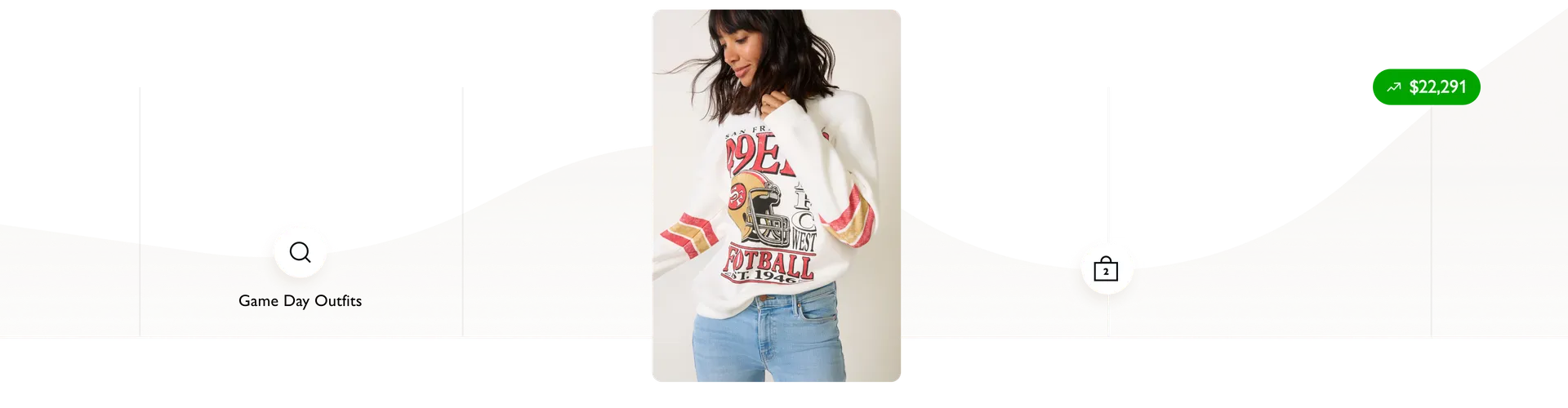
Recommendations without measurement are just opinions. After executing an approved action, Eve waits for a defined measurement window, then compares the product's current performance against its baseline at the time of discovery. It evaluates whether page views, conversion rates, and orders actually improved, whether the lift is attributable to the intervention or ambient category trends, and whether operational blockers like stockouts have emerged. Based on the results, the system decides whether to continue iterating with a new round of actions, hold due to a temporary blocker, or stop because the opportunity has been fully captured. Measurement closes the loop—and it's what separates an agent system from a suggestion engine.
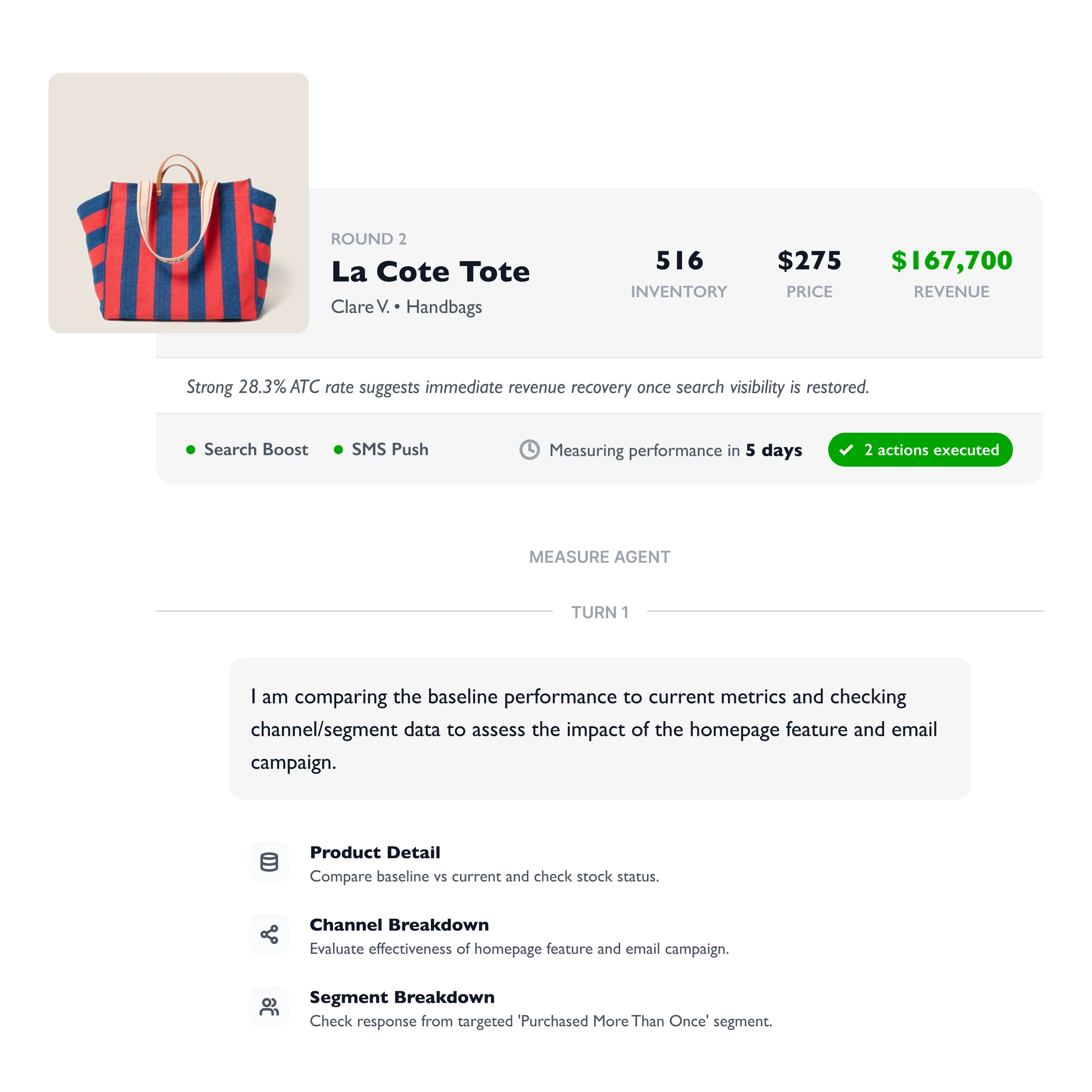
A real-time operating view for the team.
Merchandising decisions shouldn't happen in a black box. We built a dashboard that gives the team full visibility into every phase of the agent's work—from the products it's evaluating during discovery to the reasoning behind each planned action to the measured outcomes after execution. The interface streams the agent's thinking in real time, shows pending approvals with full context, and tracks every product through its lifecycle from initial discovery through multiple rounds of optimization. The team doesn't just see results—they see the logic, the evidence, and the tradeoffs behind every decision the system makes.
Iterating until the opportunity is captured.
Most optimization systems treat each recommendation as a one-shot event. Eve is built to iterate. If a first-round action improves traffic but conversion still lags, the system recognizes the remaining gap, adjusts its diagnosis, and proposes a follow-up intervention targeting the new bottleneck. Each round builds on the previous one—incorporating what worked, what didn't, and what changed in the data. The system continues cycling through discovery, planning, action, and measurement until the opportunity is fully realized or the data indicates diminishing returns. This multi-round approach mirrors how experienced merchandisers actually think, but operates at a pace and consistency that manual processes can't sustain.

Built to extend beyond one brand.
While Eve was built in close partnership with EVEREVE, its architecture was designed from the start to be reusable. The agent pipeline, data models, and tool integrations are structured around Shopify and Klaviyo as reference platforms, but the core system—discovery logic, planning heuristics, action execution, and measurement framework—is platform-aware without being platform-dependent. Connecting a new retailer means configuring their catalog, channels, and brand voice, not rebuilding the underlying agent architecture. What started as a bespoke solution for one retailer is now a white-label product ready to be deployed across the Shopify ecosystem.
Our contributions.
Development
- AI Agent Architecture
- Full Stack Development
- Data Pipeline Engineering
- Real-Time Dashboard
- Platform Integrations