
Enterprise Shopify Agent
Lumos is our agentic revenue optimization platform for retailers.
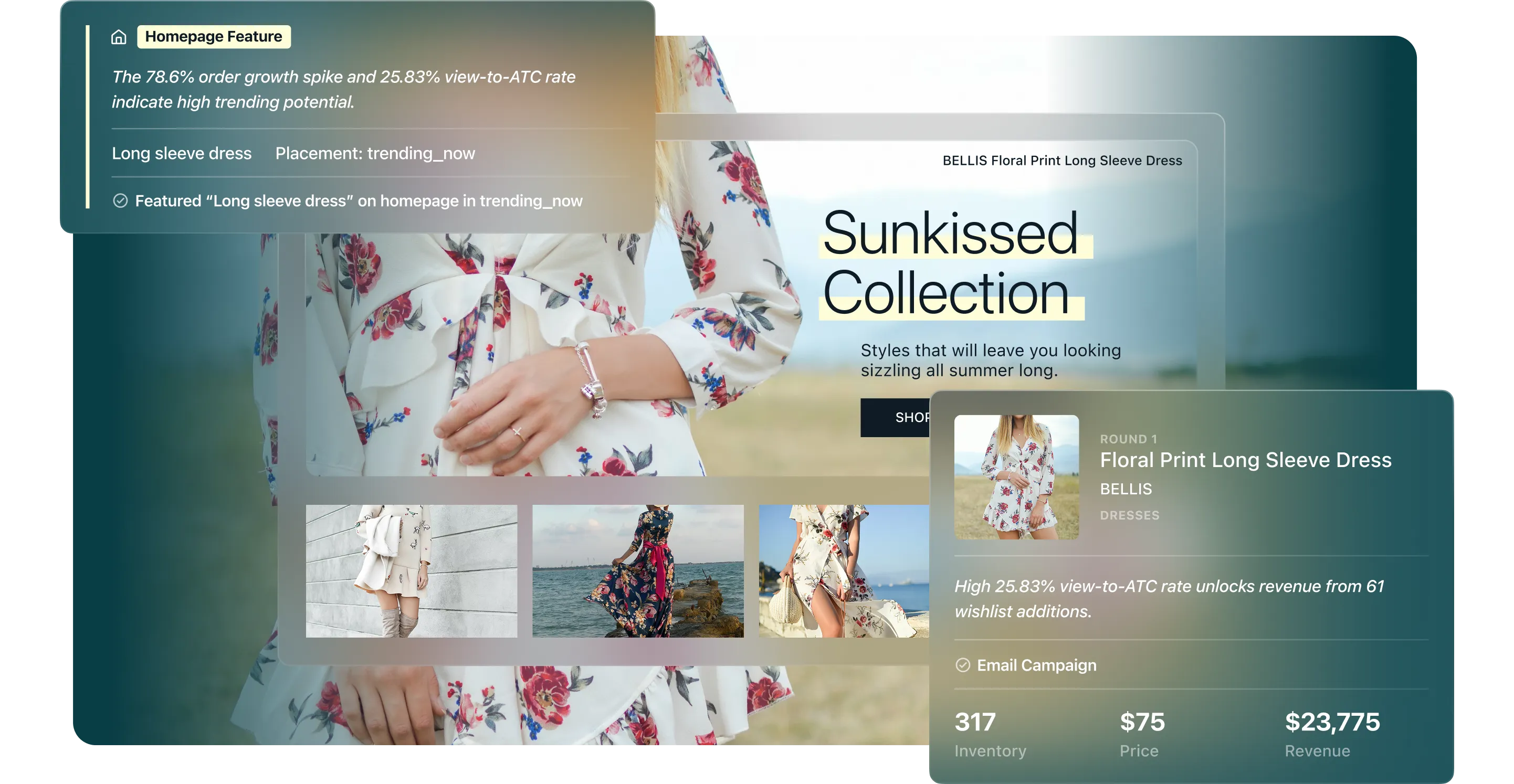
Turn product signals into revenue.
Shopify retailers already have products customers want more often than their storefronts and campaigns reflect. Lumos is a revenue optimization agent that finds those opportunities, decides what to do next, and helps teams act on them.
Built for Shopify-based retailers using customer data and messaging platforms like Klaviyo, Lumos is an agent system designed to identify underexposed products, recommend focused interventions, execute approved actions, and measure the outcome. Our agentic system connects catalog data, customer signals, and merchandising tools into a single operating loop, tailored to your product catalog, channels, rules, and voice.
How Lumos works.
Lumos runs as a four-phase loop: discovery, planning, action, and measurement. Each phase has a specific job, and each one passes structured context to the next.
-
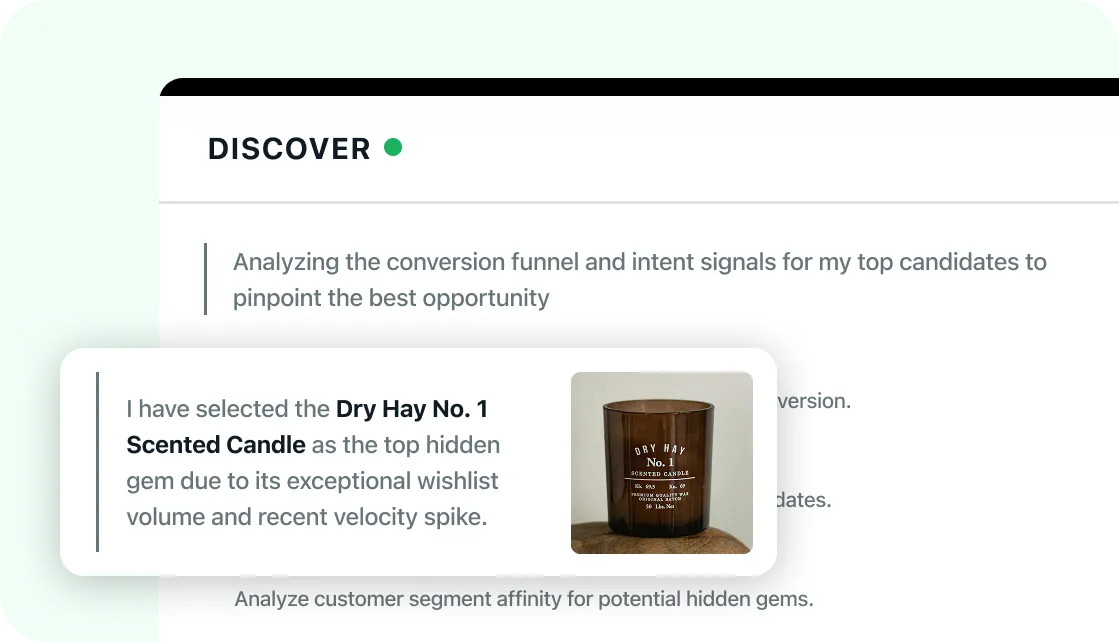
Lumos scans the catalog for products showing real demand but weak commercial performance. That can include signals like strong traffic with low conversion, unusually high add-to-cart activity, rising order velocity, or clear customer interest that is not yet being merchandised effectively.
Instead of surfacing a long list of possibilities, the system prioritizes the strongest current opportunity and records the evidence behind it.
-
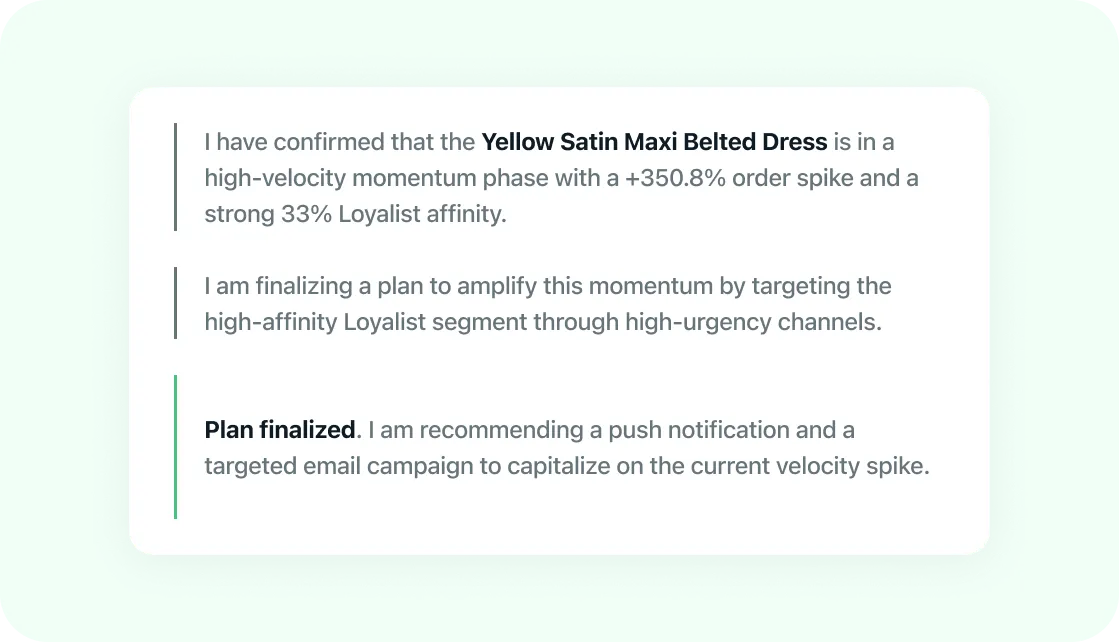
Once Lumos identifies a product, it evaluates the likely bottleneck and proposes a small set of actions. It determines what should happen next, in which channel, and for which audience.
-
Lumos can trigger merchandising and lifecycle actions such as featuring a product on the storefront, adjusting search placement, or pushing a campaign through email or SMS.
Teams stay in control. Actions can be reviewed one by one through a human approval step, or approved automatically when the operating model allows for it.
-
After execution, Lumos compares results against the original baseline. It looks at whether traffic, conversion, and sales actually moved, then decides whether to continue iterating, pause, or stop.
Measurement closes the loop. Lumos is built to learn from outcomes rather than stop at recommendations.
Built for Shopify. Ready to adapt.
Lumos is built for retailers whose stack already revolves around Shopify and customer engagement platforms like Klaviyo. Those are the current reference integrations, but the architecture is not limited to one commerce platform or one marketing platform.
The system is designed around shared data models, tool interfaces, and adapter-style integrations, which makes it straightforward to connect other commerce, merchandising, and lifecycle marketing platforms without changing the core agent loop. That makes Lumos useful both as a retail solution and as a concrete example of how agent systems can work in production: grounded in live business data, connected to real tools, and accountable for outcomes.
Why we built it.
-
Retail teams already have the data.
What they usually do not have is enough time to constantly monitor thousands of products, spot the right pattern, and act before the moment passes.
-
Dashboards don't close the loop.
Most merchandising systems stop at reporting. Lumos is built to move from signal to action to measured result.
-
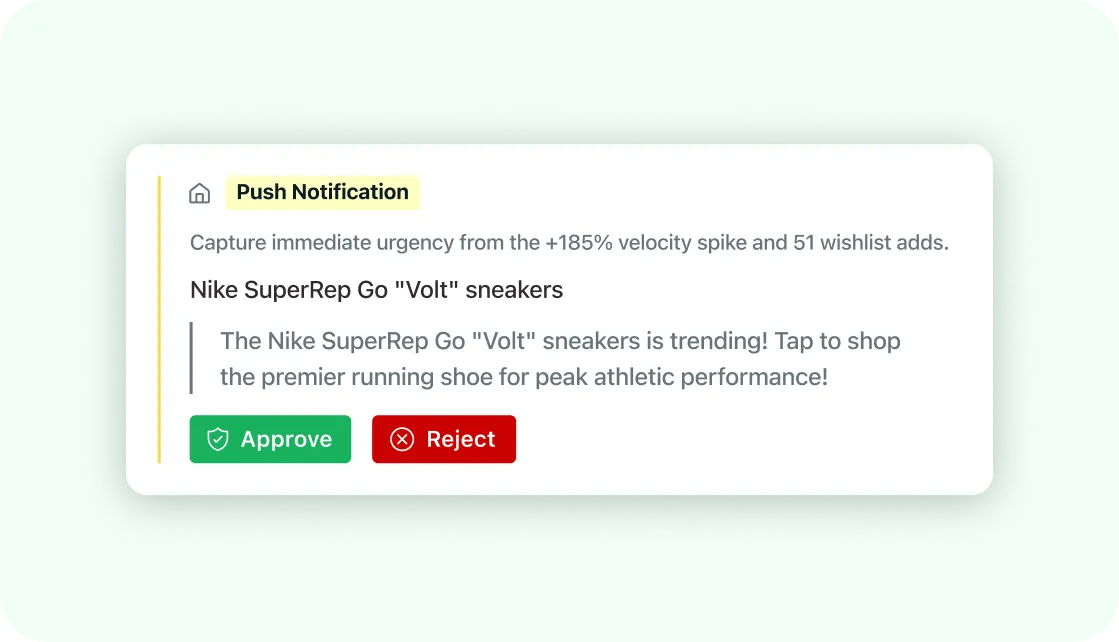
Autonomy needs guardrails.
Human approval is built into the operating model so teams can decide how much authority the system has and where oversight is required.
-
This should be reusable, not reinvented.
Lumos is designed as a white-label product that can be configured for different retailers without rebuilding the underlying agent architecture every time.
Under the hood.
For teams evaluating the technical side, Lumos uses a multi-step ReAct-style agent loop with structured outputs, tool-based reasoning, and shared context across phases.
- Discovery, planning, action, and measurement are separate agent responsibilities
- Agent outputs are validated through schemas rather than free-form orchestration
- Actions are grounded in live business data and executed through connected tools
- Human approval gates can sit in front of tool execution
- Results from each cycle feed the next decision
Who it's for.
-

Retail
Teams who want to surface revenue opportunities faster and act on them with less manual analysis.
-

AI partners
Technical evaluators looking for a concrete, production-oriented example of an agent system connected to real business workflows.
-

Non-retail
Organizations exploring what it looks like when AI moves beyond assistance and into accountable execution.

Break through with AI.
Livefront helps organizations apply AI to real products, workflows, and business problems. Lumos is one example: a production-ready agent system built to find revenue opportunities, take measured action, and stay accountable to results.
If your organization is exploring AI agents, revenue optimization, or white-label AI products, let's chat.