Article
The Most Boring Product in the World
January 6, 2026
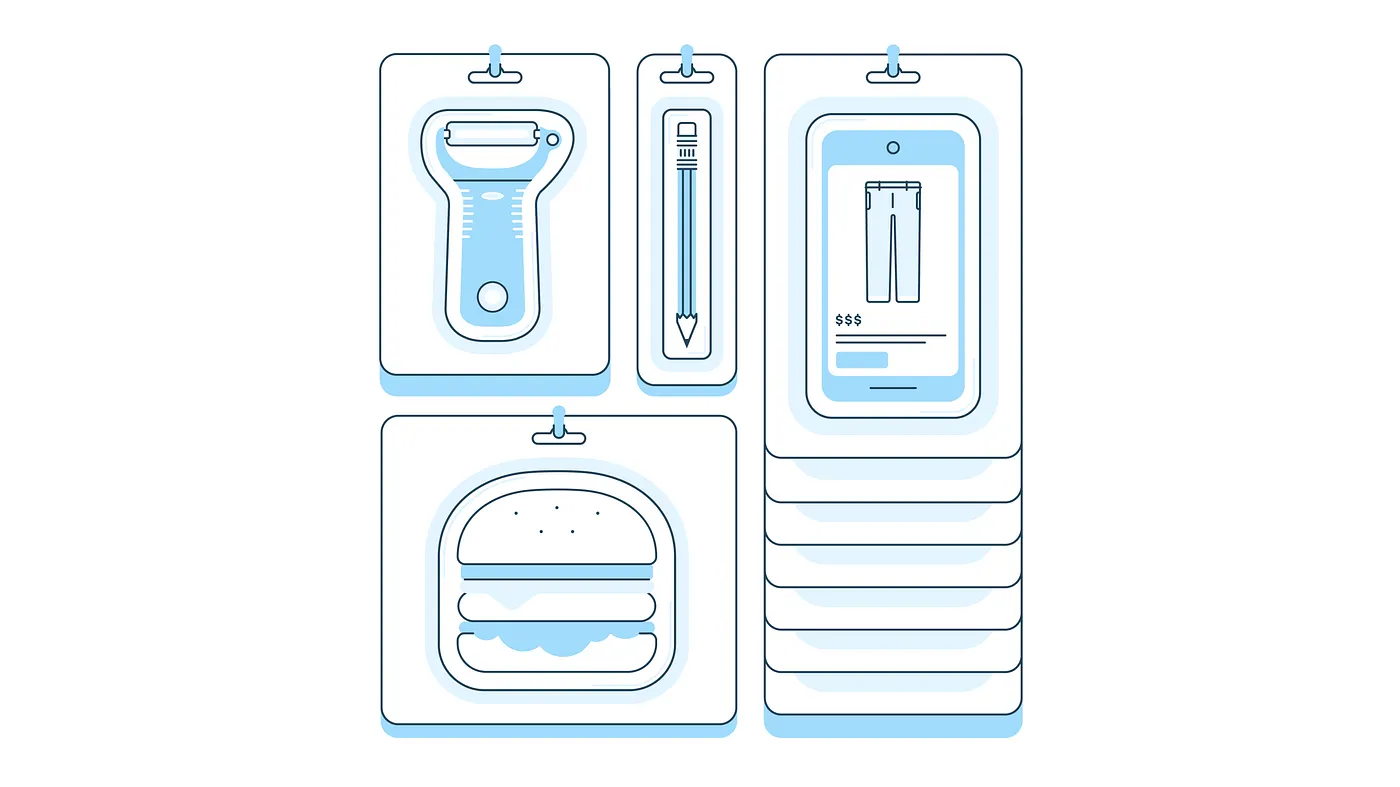
It’s the vegetable peeler.
Simple, right? It’s a blade that’s purpose-built for peeling skin off of vegetables. It’s something you buy, toss in the drawer, and use as a part of your utensil toolkit. You don’t have to think about it much, probably, because it works. It just works.
The “Y” peeler style we’re most familiar with here in the US and North America is derivative of a 78-year-old invention by Alfred Neweczerzal, the REX peeler. Here’s the original from the Swiss National Museum.
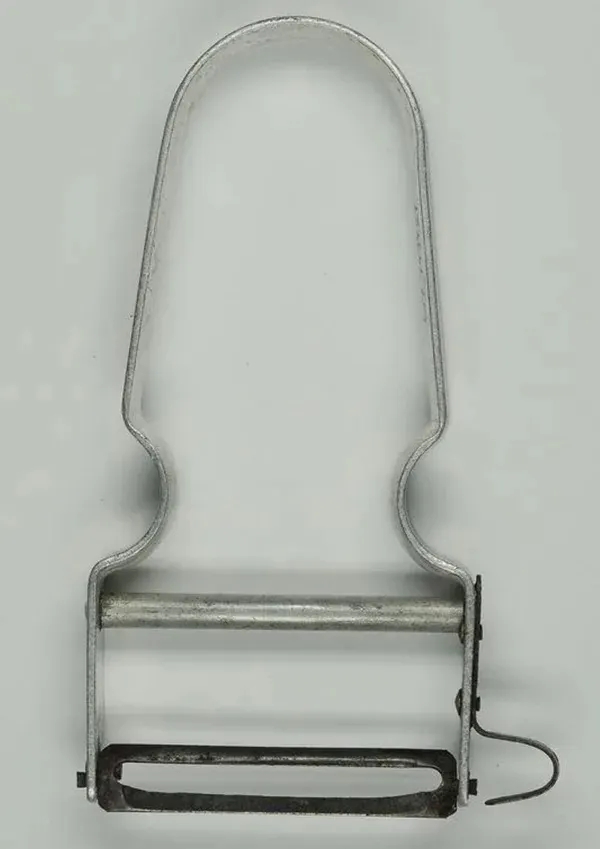
The REX may look a little minimalist — that’s on trend, right? — but you can see the heart of a peeler is there. You have a little grip indentation for your finger and thumb. The blade is horizontally-positioned, as opposed to perpendicularly-positioned as with some peelers. There’s a roller to help the veggie peel fall away from the tool, and probably one of the sharpest blades ever. The little steel loop next to the blade? It’s a potato eyer — the official term — for getting eyes out of potatoes. It’s not the main feature but it makes sense to have an eyer there, since you’ll need to remove potato eyes before peeling them. This is a completely functional tool that has a simple beauty about it. It is supremely functional. It works. It works really well.
One is bound to find interesting things when researching the history of the humble peeler. There were hundreds of patents for peelers in the late 1800s and early 1900s, a real time of innovation in vegetable peeling. But I found more information about OXO — recency bias in the house! — as it launched the Good Grips line of products in the 1990s with a peeler featuring a thick, rubber handle and fins to make it easier to grip. As someone who occasionally deals with grip issues, I can say this is a huge step up from the original. Nice eyer, too.
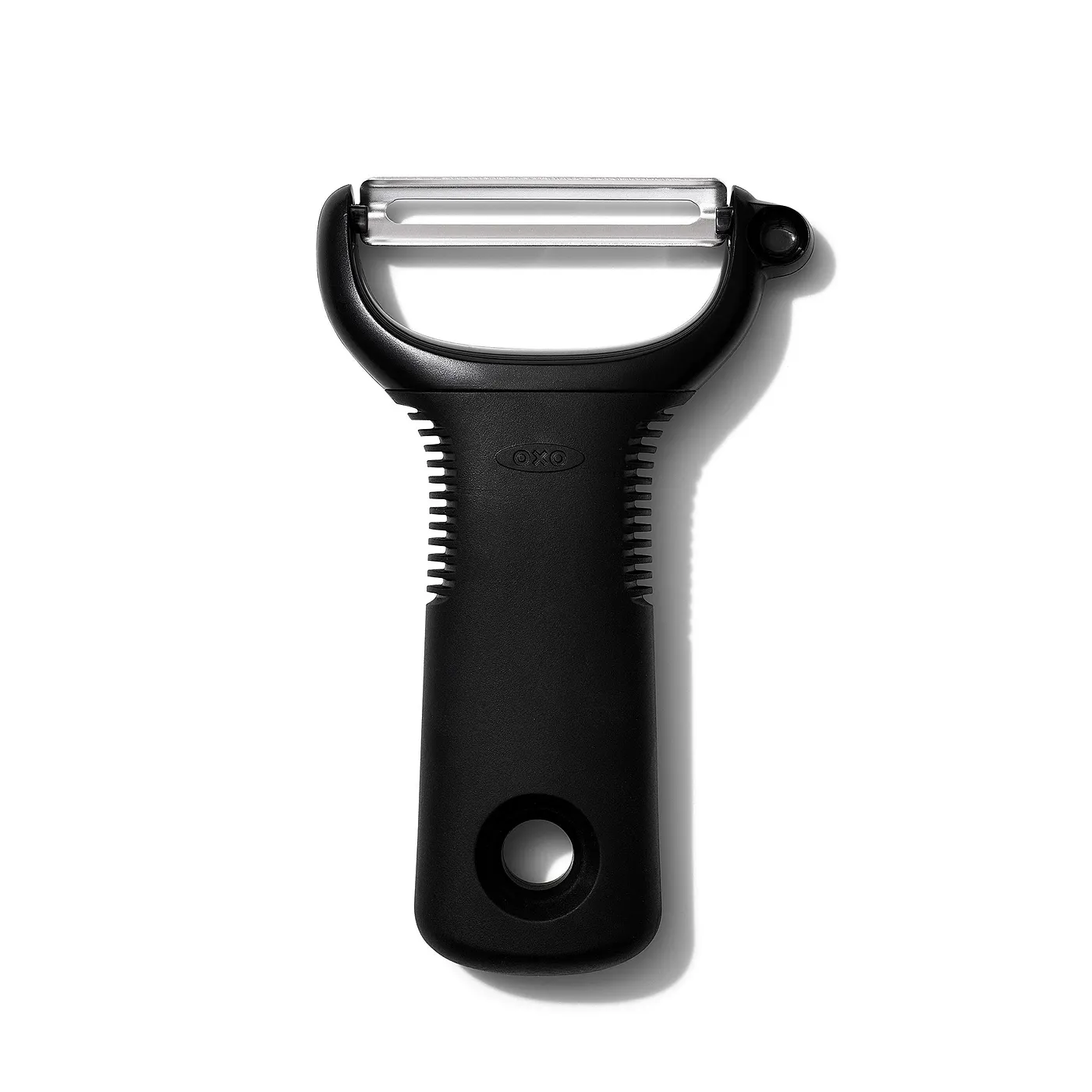
Whether OXO’s contribution to the history of vegetable peelers is long lasting remains to be seen; it certainly has endured for 30 years, spawning lots of competitors and copycats. Clearly they got something right.
You may have a different idea of what the most boring product in the world is. I asked a number of folks on LinkedIn about it and got a few other great answers like keys (which are fascinating and super complex!), cutting boards, pens, pencils, the electric kettle, a toothbrush, even soap. All amazing answers. These products were all invented at some point in the past yet the innovation phase is so far in the rearview that we now think of them as commonplace, routine, functional, and maybe boring.
But on balance: these are products that do their job. Do it well. Get out of the way. Don’t require a ton of thought. But are reliable, useful, and lowkey great. And isn’t that something we should shoot for when creating products nowadays?
There’s immense pressure from all corners to make products that are innovative. It’s pushed high technology from a casual hobby of the 1980s into well beyond mainstream in the 2000s and a major driver of our daily lives here in the 2020s. But I want you to think about what it means to be innovative, why this is important, and why — and when — it’s also not important.
This said, I am very happy to reveal that there are “smart” veggie peelers available on the market.
Before I tell you more take a moment to think about what that means. The features you’re already envisioning. Maybe a screen. Perhaps an app. A Bluetooth speaker in the handle. Thoughts of, “Really? Is that true?” and “Huh, I wonder if it requires Wi-Fi 6” are probably bouncing around your head.
In fact, there is no network setup, no screen, no required app, no automatic counting of how many potatoes you peeled last week (81, and you know it.) Because “smart” peelers don’t mean the same thing you’re likely thinking of. One group of smart peelers includes a plastic compartment to capture fallen veggie peels. Another group is battery-powered, great for people who aren’t able to peel their vegetables.
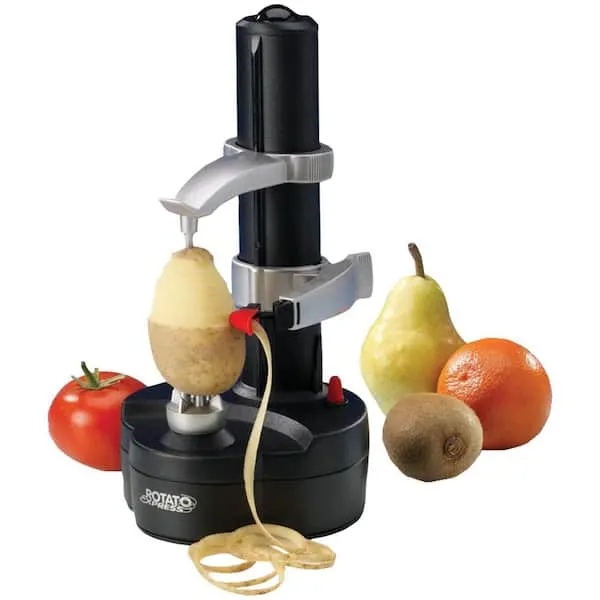
The fact that you may have initially thought about screens and apps for our lowly veggie peeler says something. First, it demonstrates how much value we project on to the idea of a “smart” appliance. A coffee maker, a toaster… we can start to imagine how these features could maybe take their places, even if they’re not great ideas.
My wall oven, for example, includes a touchscreen interface. It’s a horrible design in part because it mistakes steam arising from an open oven as presses on its screen. Suddenly I’m not baking cookies at 350 degrees; instead the oven thinks it’s 2:41pm and I want to broil fish. However! I can also control my oven remotely via an app, a feature which I would never ever use.
My example, and the Bluetooth veggie peeler, also show how much those ancillary features truly wouldn’t make sense. At this point, OXO’s work might very well be the last major iteration of a handheld manual peeler. My oven pretty much does everything an oven should do. Anything else at this point feels straight up gimmicky; another attempt to add something that isn’t really valuable, but just takes up more space.
As product owners and designers, we’re tasked with creating and shipping things that are valuable. We have clear ways to measure that value in a prototype testing environment and out in the real world as well. But let’s be clear on what the value is and for whom something is valuable.
There are many times when it’s important to be boring. When you’re creating a shopping experience, for instance, you’re probably not going to stray far from something like this.
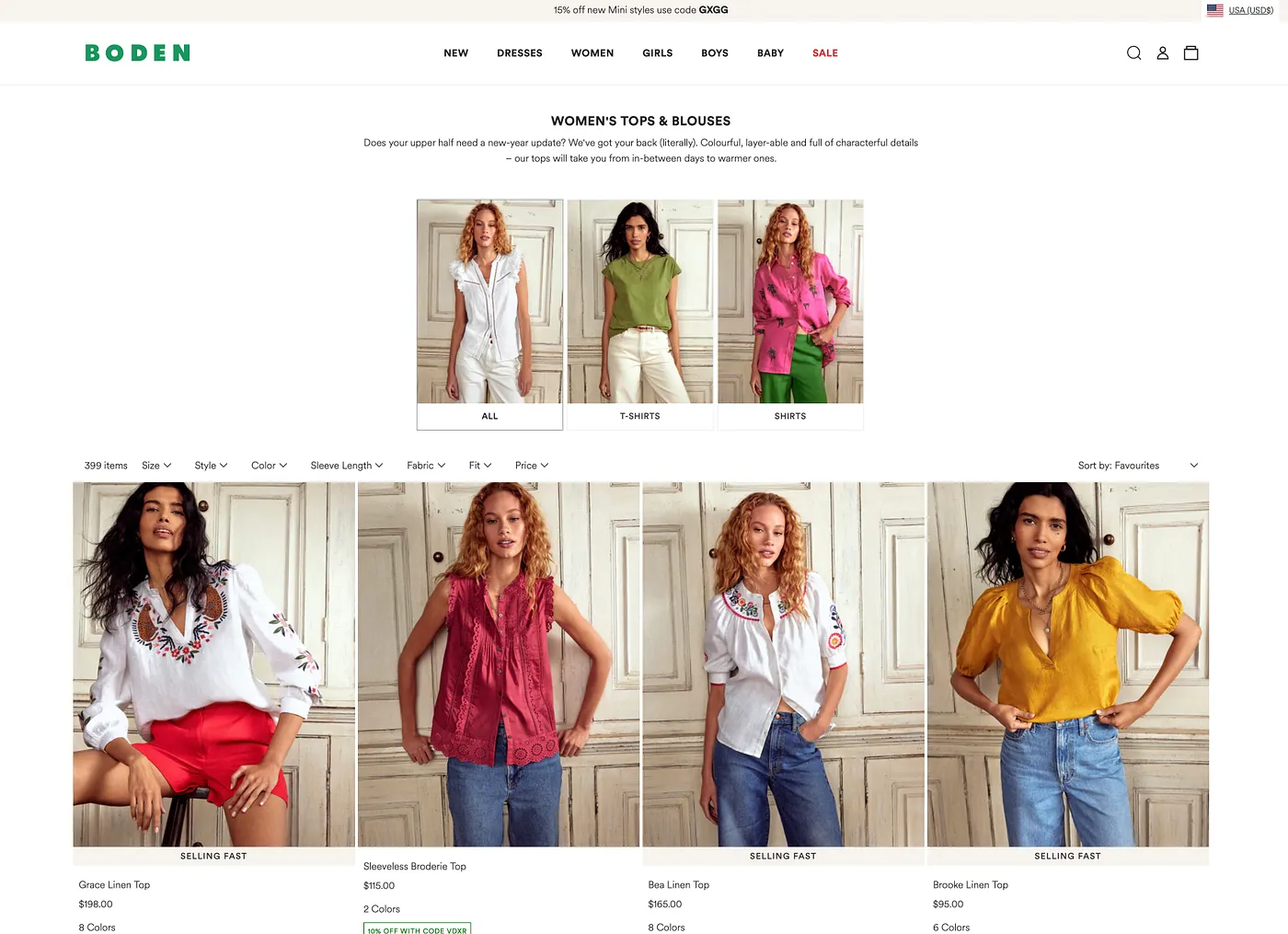
This is Boden’s site, as you can see, but it might be the site of any brand you can think of. There are small variations here and there — navigation placement, size of the grid — but if you’ve used the web or an app within the past 5 years you can quickly surmise what this is and what it does. In fact, you probably can guess what the product details page (PDP) will look like and how it will function, along with the shopping cart and checkout — and you’d be right! (…Within a tiny margin of error.)
These are boring. And yet, they’re critical to getting you into a nice new top. Or buying a new veggie peeler. Or maybe buying a new car, even. This is a consistent experience that has been honed over 30 years of e-commerce and, for the most part, sees little variation. It’s why we can do things like build out these screens and pages so rapidly. I’m not saying that innovation in e-commerce is gone, but rather we’re at a place where we’re looking at iterations on an established pattern — the OXO Good Grips peeler in multiple colors instead of the REX, or a compartment for a peeler instead of a speaker.
This is where the art of product and design truly come to the fore: it’s a balance of wants and needs that identify where it makes the most sense to create something new. Your checkout flow probably doesn’t need to be innovative. It does need to work, it does need to feel like a part of your enveloping experience, and it does need to confidently get people to where they’re going.
When reviewing a backlog or soliciting ideas in workshops, don’t dismiss the boring things. In fact, those are features that should get just as much attention as the non-boring ones since they serve as the foundation for greatness whilst being great in and of themselves. If your team designs, develops, and ships a feature that works for a decade without any issues, isn’t that a valid metric of success? It’s so pushed into the background that it doesn’t get a moment’s notice or a flashy moment in an analytics dashboard.
But maybe it should. And maybe we shouldn’t overlook the boring things that are built well and last forever.